
A Safe Place to Be a Child Again: How EU Support Is Helping Ukrainian Children Heal
29/03/2026
Life under occupation, injury, evacuation, and then another injury. This is the story of a family from the Kharkiv region whose life was forever changed by Russia’s full‑scale invasion. The Slovianske Sertse Charitable Foundation and Save the Children, with the support of the European Union, offered them a helping hand during one of the most difficult periods of their lives.
In 2022, Olha and her 7‑year‑old son Heorhii (names changed for safety reasons) lived through Russian occupation. After their village in the Kharkiv region was liberated, the enemy began to actively shell the settlement. During one of the attacks, Olha was injured and decided to evacuate with her son. The family found a new home in a small town in the Kharkiv region, where they once again came under a missile strike.
Both Olha and Heorhii still have shrapnel in their bodies, which doctors were unable to remove. Olha’s eyesight has deteriorated, she limps due to a leg injury, and cannot stand for long, while young Heorhii has an injured arm. After the second injury, Olha turned to the Slovianske Sertse Charitable Foundation. There, the family received social support, as well as financial and psychological assistance.
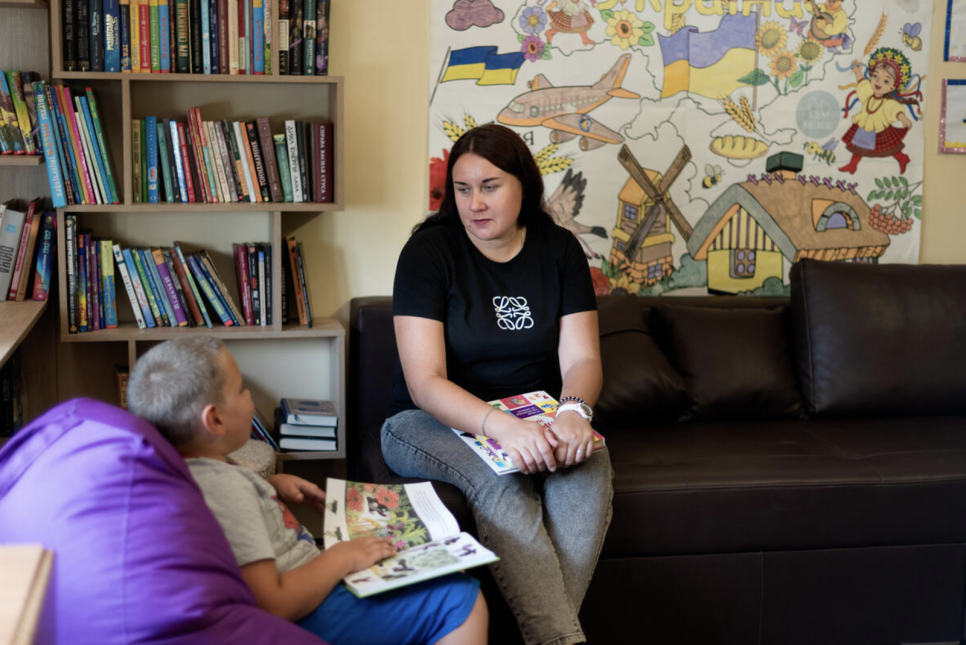
Olha and her son Heorhii
Photo: Hanna Azarova / Save the Children
“The mother was emotionally exhausted. She did not know what to do or where to turn. There were also problems with her child’s schooling: it was time for him to start his first year at school, and she did not know how to proceed. The child needed to socialise. When they were evacuated, both the mother and the child were frightened. They were unable to communicate, make friends, or understand where to seek help,” as staff at the Slovianske Sertse Charitable Foundation recall the beginning of their work with the family.
The family was helped to adapt to the new city: Heorhii was enrolled in the local school, they were provided access to medical services, and assisted in obtaining state benefits. In addition, they received cash assistance to cover travel to other cities for medical consultations, as well as medicines and related expenses.
“I would like to work, but it is difficult for me. I trained as a cook, but even when I make dinner at home, I cannot stand by a hot stove. The shrapnel heats up and causes me great pain. I have also had problems with my leg,” Olha explains.
A social worker from the Slovianske Sertse Charitable Foundation invited the family to a local child‑friendly space. It was opened in 2023 with the support of the international organisation Save the Children and EU funding. Since then, the centre has supported 1,972 children.
“At first glance, it may seem that in a child‑friendly space, children are just playing. In fact, we conduct many structured activities. For example, the body‑oriented psychological support programme Team Up, through games and physical exercises week after week, teaches children to work in a team and to develop and maintain social skills,” says Sonya Kush, Director of Save the Children in Ukraine.
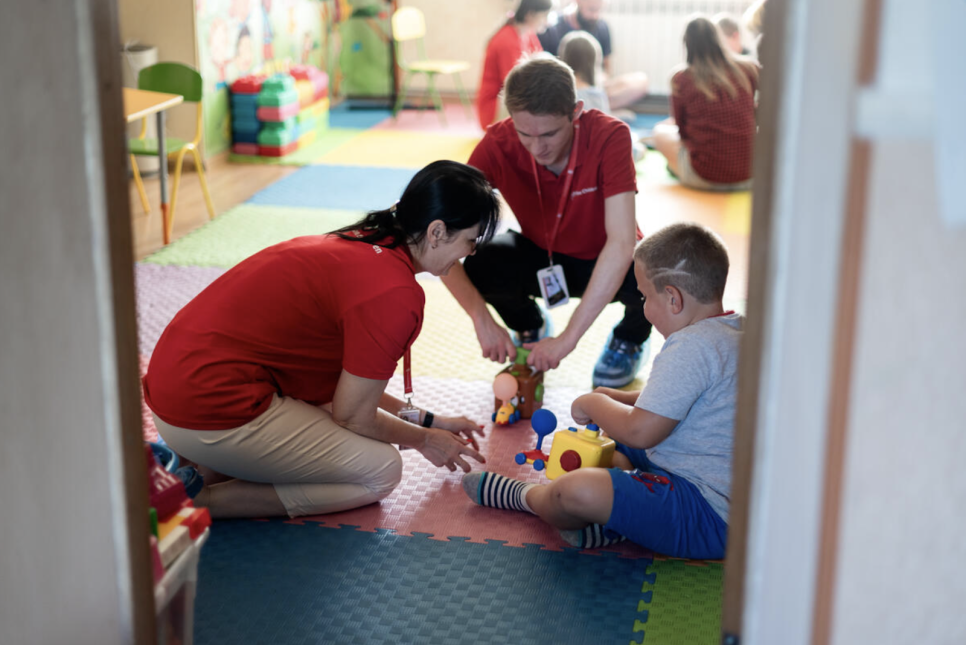
Heorhii with staff at the child‑friendly space. Photo: Hanna Azarova / Save the Children
The HEART (Healing and Education through the Arts) programme allows children to process and express their feelings, experiences, or ideas through creativity. Thanks to the children’s drawings, facilitators can see what worries them, provide basic psychosocial support, and refer them to a psychologist or psychiatrist. “Each facilitator must first undergo training on how to work with children and how to recognise specific needs in emergencies,” explains Kush. The European Union covers the facilitators’ salaries, their training, and the learning materials used in the child‑friendly space in the Kharkiv region.
Kush says the impact of child‑friendly spaces is measured by changes in children’s behaviour. Both facilitators and parents say that children become calmer, more emotionally stable, and more self‑confident.
The support that Heorhii receives in the space is also bringing positive results. His mother is pleased to see that her son is developing new skills and becoming more active. The boy dreams of going to the seaside, of doing pottery, and, when he grows up, of working as an emergency doctor to save people.
“We have been attending the child‑friendly space for a year now. My son really likes it here. At home, he often suggests that we do the same activities they did in the space. And when I come to pick him up, he asks to stay a bit longer,” says Olha.
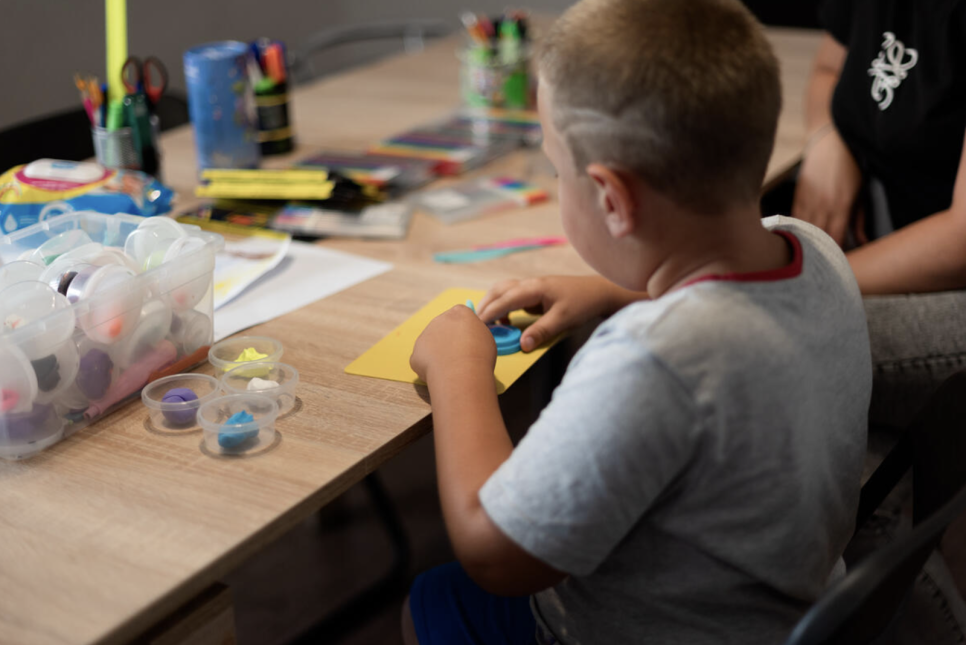
Heorhii. Photo: Hanna Azarova / Save the Children.
Across Ukraine, Save the Children has opened 14 safe spaces for children. Some of them are stationary, located in underground facilities. Others are mobile and travel to villages to be where the children are. Some operate 5 days a week, while mobile spaces provide services only a few days a week, for safety reasons. Two spaces — in the Kharkiv and Kherson regions — were opened with EU financial support.
“We are deeply grateful to the European Union for understanding the importance of children’s safety and protection in emergencies and for investing significant resources in creating child‑friendly spaces,” sums up Sonya Kush.Since the beginning of the full‑scale invasion, one in five children in Ukraine has lost a relative or a friend (as of February 2025), and 4.6 million children face problems accessing education. To support them, the EU invests in social initiatives such as child‑friendly spaces. It also supports projects that enable children with special educational needs to study alongside their peers in mainstream classrooms and that engage all children in active social life. The EU remains a reliable partner of Ukraine on its path towards building a society that cares for every child.
Source: Nakypilo