
How social entrepreneurship in educational institutions shapes a new generation of Ukrainian entrepreneurs with the support of EU4Youth
25/02/2026
Social entrepreneurship in educational institutions turns schools into spaces of real action, where students learn by creating, deciding, and taking responsibility for their communities. In Europe, such models have long been integral to modern education: pupils and students do not merely study the basics of economics or entrepreneurship – they learn how to act, create products, work in teams, make decisions, and recognise the social value of their work.
In Ukraine, social entrepreneurship in educational institutions has been developing actively in recent years as a response to society’s demand for practical education, entrepreneurial thinking, and an active civic stance among young people. This approach has gained particular importance during the full-scale war, when communities need initiative, mutual support, and new leaders here and now – not ‘after graduation’.
This logic is supported by the programme ‘EU4Youth: Youth Employment and Entrepreneurship’. In Ukraine, the programme is implemented, among others, by the organisation School of ME, which helps educational institutions launch social enterprises.
Four social school enterprises launched and operating with European support – ‘School Beehive’, ‘Mylotvortsi’, ‘Smart Mushrooms from the School Greenhouse’, and SHAFA MARVEL – differ in form but are united by a common idea: educational institution can be a place where young people gain their first experience of working with social impact.
From a beehive to civic responsibility: the story of the social school enterprise ‘School Beehive’
The social school enterprise ‘School Beehive’, which started in May 2021 in Kyiv Region based on the NGO ‘Nova Kalyta’, Zavorychi Gymnasium, and the educational hub institution Kalytianskyi Lyceum, introduces children to the basics of entrepreneurship through the traditions of Ukrainian beekeeping.
The project began with the creation of a school apiary with six beehives and later scaled up: an api-house was built, a hotel for wild bees appeared, and nectar-producing plants were planted. In 2025, ‘School Beehive’ was ranked among the top five social school enterprises in Ukraine, receiving the StudBiz Award 2025 (annual award for Ukrainian social enterprises in educational institutions).
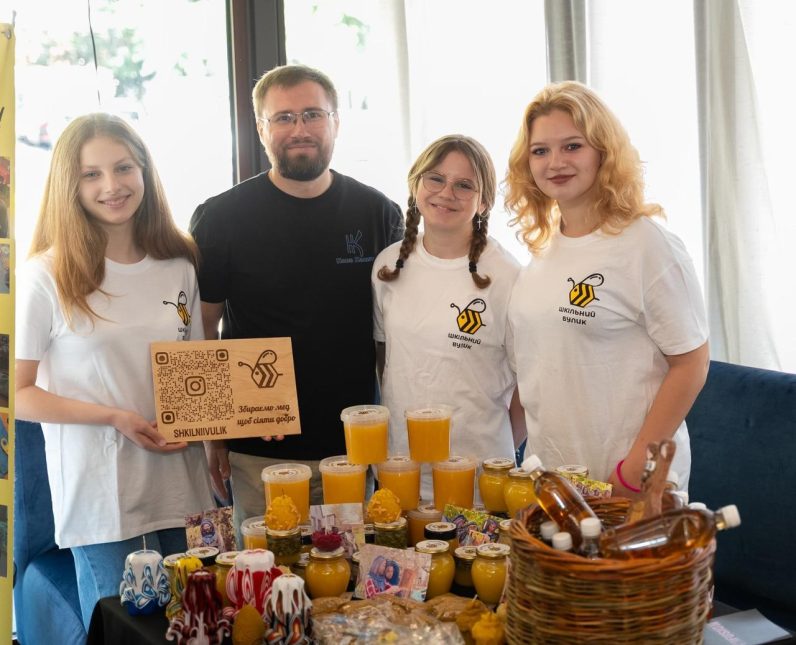
The social component here is not just declarative. Fifty per cent of the profits from honey product sales are allocated to free workshops for children from internally displaced families and families of military personnel. In total, around 900 children from socially vulnerable groups have already participated in these workshops.
The project survived occupation and the loss of access to part of the beehives, yet retained its team and motivation. Today, 35 regular participants are involved, and some former participants have already launched their own apiaries on their family plots.
‘This project is more than just about a beehive, bees, or business. It is about life and for life’, emphasises project curator Evhen Zaika.
The students say that through the project, they have learned to see things through to the end, negotiate, support those who are more vulnerable, and not be afraid to take initiative. They view entrepreneurship not as a way to make money, but as an opportunity to be useful to their community.
‘Mylotvortsi’: when kindness has a business model
The social school enterprise ‘Mylotvortsi’, established in 2021 at Lyceum No. 203 in Kyiv, has been proving for five years that entrepreneurship can be a tool for raising responsible citizens who are sensitive to the needs of others.
Over this time, the enterprise has gone through several stages of development: from eco-bags made of recycled denim to clothing printing and soap making. The team has survived the pandemic, the full-scale Russian invasion, and the forced separation of participants across different countries, yet it never ceased operations.
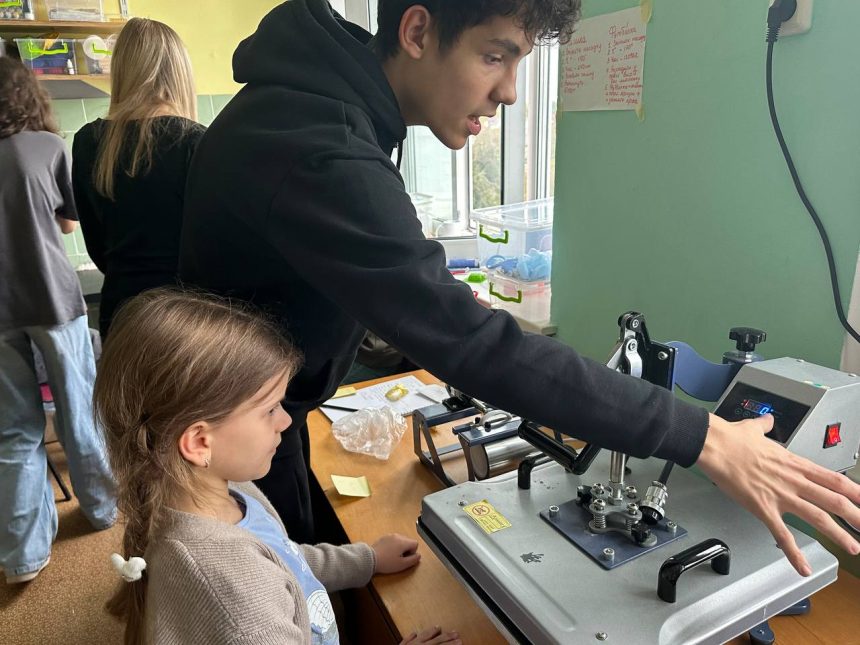
Today, ‘Mylotvortsi’ brings together 14 teenagers aged 14-16 who independently plan production, calculate costs, sell products at fairs and workshops, and regularly allocate part of their profits to charity.
The project has twice received support as a successful social school enterprise and mentoring assistance from School of ME. Graduates of the team admit that their experience in ‘Mylotvortsi’ became the foundation for launching their initiatives in adult life.
‘Social entrepreneurship teaches how to turn challenges into ideas and solutions’, notes project curator Nataliia Pavlova.
Project leader Maria Kolisnyk emphasises that social school-based entrepreneurship is, among other things, a powerful tool for self-realisation: ‘For me, participation in this project is about opportunities, whether we are talking about personal development or sharing one’s own experience with others. Thanks to the social school-based enterprise established at our institution, many teenagers have the chance to discover a new world where anything is possible. The project allows me to develop my skills and knowledge without limitations — this is what motivates me and helps me find new paths to success’.
‘Smart Mushrooms from the School Greenhouse’: a harvest measured not in kilograms
The project ‘Smart Mushrooms from the School Greenhouse’, implemented by the NGO ‘Association of Parents and Teachers ‘QUIZ’ at Tysiv Lyceum of the Bolekhiv City Council in Ivano-Frankivsk Region, is an example of how STEM education, entrepreneurship, and social responsibility can be combined within one space.
The idea emerged during the lyceum’s participation in the international StudBizEU project, implemented by School of ME. After training for teachers, workshops for students, and teamwork on a business model, the pupils decided to grow greenhouse mushrooms, converting the basement of a former school shooting range for this purpose.
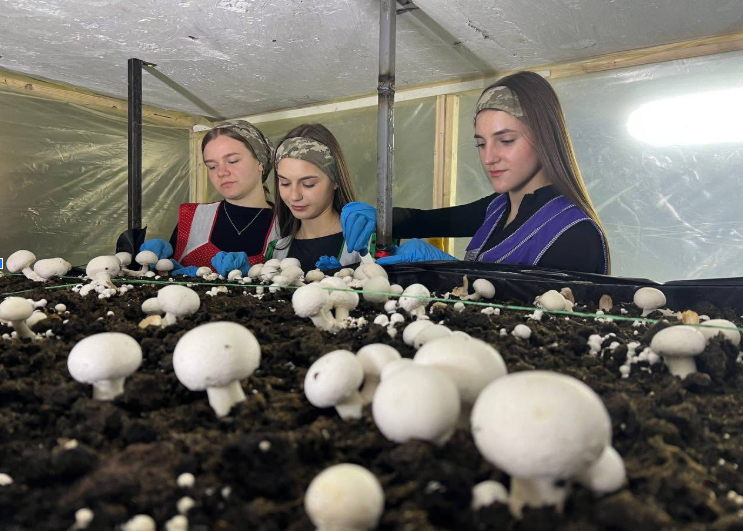
In spring 2025, the team became one of six finalists in the project and successfully launched production. But the main result is not the harvest itself. Part of the profits is directed toward improving the conditions of a local radiation shelter and supporting an educational environment for children with special educational needs.
The project is integrated into school subjects – from biology to computer science – and has a long-term goal of becoming a model that can be scaled to other schools. Pupils also note that the project helps them develop leadership qualities, as well as the ability to make choices and take responsibility for decisions.
‘We grow not only food, but also confidence, experience, and the power to act’, the team members emphasise.
Creating, supporting, restoring: the path of SHAFA MARVEL
The social youth enterprise SHAFA MARVEL, established in partnership with the NGO ‘Creative Space Sumy’ at the Sumy Higher Vocational School of Construction and Design, began its practical activities in January 2025.
SHAFA MARVEL is a service that creates complete looks, offering custom tailoring, costume rental for events and photo shoots, makeup, and hairstyling. At the same time, the enterprise has a clear social mission – supporting inclusion, environmentally responsible consumption, and war veterans.
Youth aged 16-18 take part in the project while training as tailors, pattern makers, fashion hairstylists, and makeup artists at the Sumy Higher Vocational School. Becoming part of the SHAFA MARVEL team, they went through the entire cycle of real entrepreneurial activity: from developing a business idea and financial model to working with clients and partners.
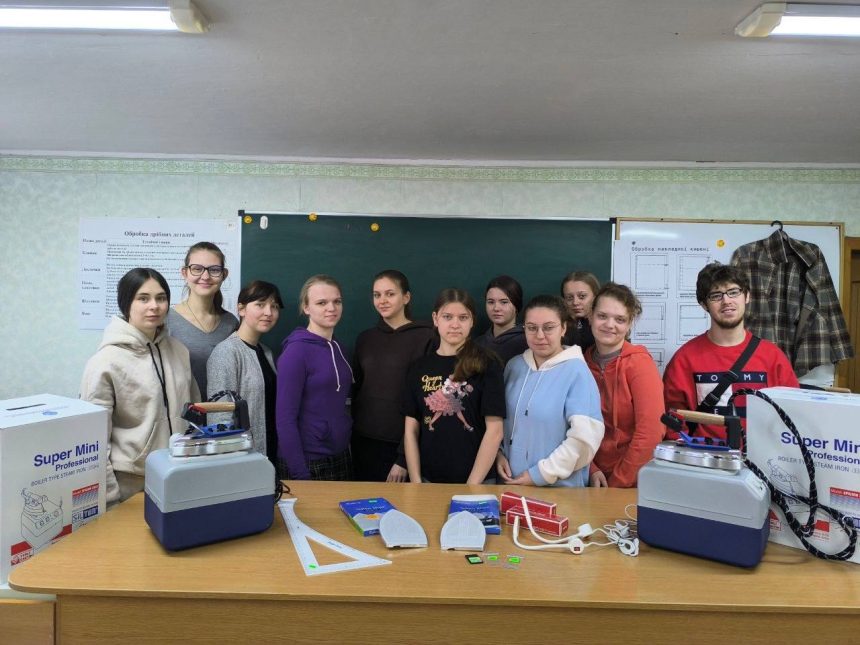
Separate areas of activity include free services for children with special needs, a clothing rental service, the ‘EcoDenim’ project for recycling denim products, and the production of adaptive clothing for veterans with vision loss. The enterprise collaborates with event agencies, photo studios, inclusive spaces, and charitable organisations, confirming both the practical value of its services and the demand for them.
The SHAFA MARVEL portfolio already includes tailoring T-shirts for veterans with vision loss and an invitation to join the team creating functional clothing for veterans at Ukrainian Fashion Week 2025/2026.
‘I attended a discussion panel at Ukrainian Fashion Week 2025/2026 with veterans who have lost their sight and limbs – people, thanks to whom I have the opportunity to live and study. I saw how important it is for them to have clothing adapted to their needs. And this is exactly what we do. I am proud of it. Social youth entrepreneurship is the activity that gives me the broadest opportunities to strengthen essential life skills for building a successful career’, notes SHAFA MARVEL representative, student Nadiia Pekurovska.
After significant damage to the educational and production buildings of the Sumy Higher Vocational School of Construction and Design in September 2025 as a result of a Russian attack, part of SHAFA MARVEL’s income has been directed toward restoring the educational space. This helps the institution to operate.
Social entrepreneurship as an investment in Ukraine’s future
‘School Beehive’, ‘Mylotvortsi’, ‘Smart Mushrooms from the School Greenhouse’, and SHAFA MARVEL – their stories prove that social entrepreneurship in educational institutions shapes a generation that knows how to act rather than wait. Through such initiatives, educational institutions become places where profit is combined with responsibility, and education directly impacts the community.
“Social enterprises in educational institutions are an investment in Ukraine’s future. They teach young people to identify problems, take responsibility, and create solutions. Working with educational teams across Ukraine, we see how real entrepreneurial practices shape these skills in teenagers. And with the support of partners, such models become not isolated cases, but part of systemic changes in Ukrainian education”, said Artem Kornecky, head of School of ME.
In times of great challenges, it is through such initiatives that young people learn to act, take responsibility, and contribute to Ukraine’s European future.
Background information:
The EU4Youth Phase III Youth Employment and Entrepreneurship programme, funded by the European Union and the Ministry of Foreign Affairs of Lithuania, is being executed by the Central Project Management Agency (CPVA) in Eastern Partnership countries. These include Armenia, Azerbaijan, Belarus, Georgia, Moldova, and Ukraine. The programme will run until the middle of 2026 and aims to provide technical assistance to governmental and non-governmental organisations to tackle youth unemployment and improve employability.