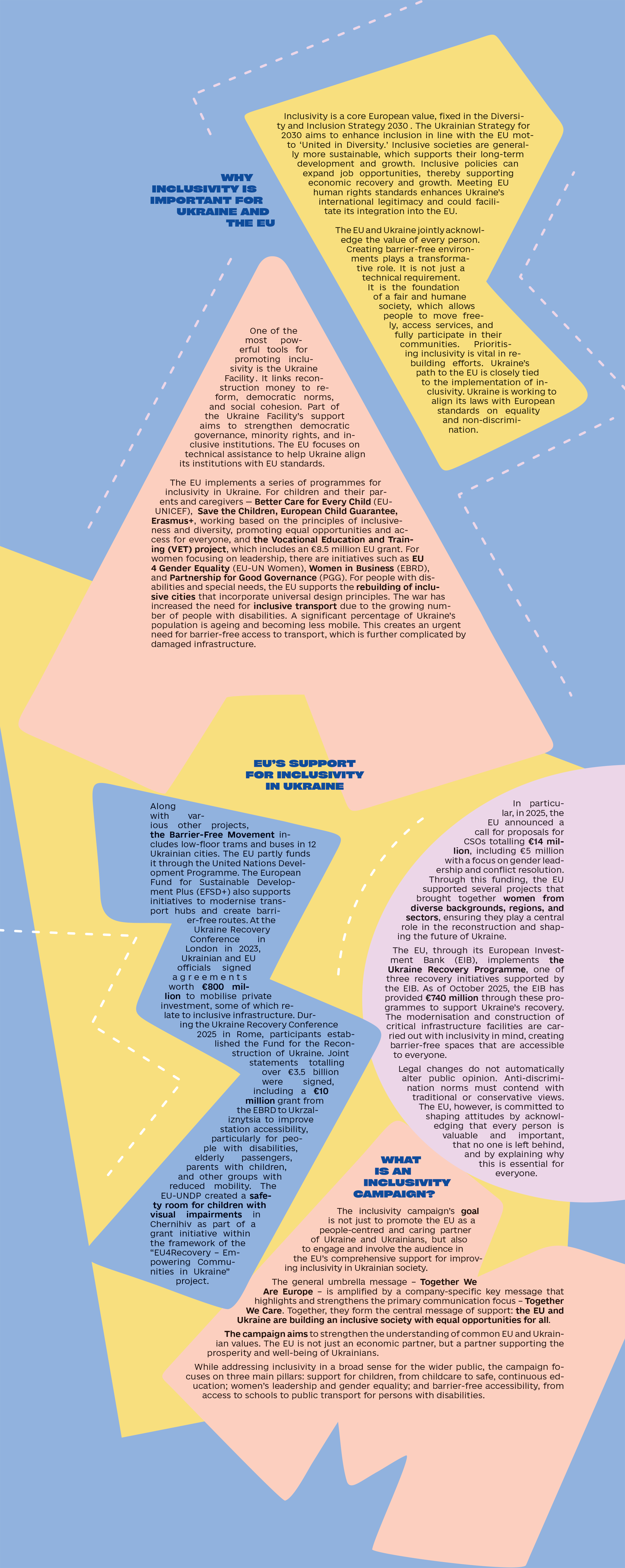
The European Union is helping Ukraine not only on the economic and institutional levels. The initiatives it supports also have a tangible impact on people’s daily lives, especially those of the most vulnerable.
On November 20, 2025, on the occasion of World Children’s Day, the EU Delegation to Ukraine launched the #TogetherWeCare communication campaign.
Together, we are working to ensure that everyone in Ukraine can live with dignity and realise their potential.

Ruslan. Accessibility and mobility
Ruslan is a driver of a modern low-floor bus in Kyiv.
It is now fully equipped to accommodate the needs of passengers with reduced mobility. Thanks to the support of the EU and the EIB, the capital will receive 85 of these accessible vehicles.
Yulia. Schooling free from alarms
More than 1,000 children aged 5 to 9 study in underground schools in Kharkiv. Among them is 6-year-old Yulia.
Yulia and her peers continue to attend their lessons in the Kharkivmetro, even under the constant threat of Russian air strikes.
Defender Ihor Popovych. Return to movement
During his military service Ihor suffered a stroke and couldn’t move but with a wheelchair. He is currently undergoing rehabilitation at the Volodymyr Hospital.
Thanks to EU funding, the hospital is now using AI-driven robotics, which have already helped more than 700 patients.
Nina and Olena. Social adaptation story
For over a year, Nina Hladenka and her daughter have been visiting the Social Adaptation Space in Pryluky, Chernihiv Oblast.
For Olena, who has lived with cerebral palsy since childhood, it’s a chance to be among friends and feel part of a community.
Navigating your own city shouldn’t be a daily obstacle
Veteran Ruslana “Unbreakable” Danilkina knows firsthand the challenges people recovering from war-related injuries can face. After sustaining a serious injury and undergoing rehabilitation herself, she now helps others regain their independence and mobility.Recently, Ruslana and EU Ambassador to Ukraine Katarína Mathernová took a ride on one of Kyiv’s new low-floor buses. Equipped with ramps, step-free entry and designated spaces, these buses make everyday travel more accessible and dignified for all. With EU support through the European Investment Bank, Ukrainian cities are now expanding their barrier-free public transport networks.
🎥 Watch the video to hear their conversation and see why accessible transport matters
Lyudmyla. The power of being there
Lyudmyla is a former soldier. After losing her husband at war, she began to care for five foster children. The project “A Family for Every Child: Developing Family Foster Care” provided the family with household appliances, warm clothing, and financial support.


“TOGETHER WE CARE. TOGETHER WE ARE EUROPE”
On December 5, 2025, as part of the XIV Civil Society Forum at the Mystetskyi Arsenal, a special interactive zone was opened.
The visitors had an opportunity to:
- take an instant photo at the thematic photo zone;
- share their vision of an inclusive society;
- get a personal motivational message.



Promoting unity, equality, solidarity, social cohesion, a participatory approach, and inclusivity are crucial to Ukraine’s recovery process, mitigating the destructive effects of the war, ensuring the effective functioning of Ukrainian society and the economy at all levels, and fostering the development of economic and human potential. However, war pressures, infrastructural gaps, social attitudes, and other significant challenges hinder progress towards inclusivity. Civil society, international organisations, and the government are working on reforms. The EU’s support also facilitates making life in Ukraine more inclusive.

The war has exacerbated the need to adapt infrastructure for people with disabilities. According to the Ministry of Social Policy, there were officially over 3 million people with disabilities in Ukraine as of 2024, and more broadly and unofficially, over 6 million people are estimated to have a disability. These numbers are growing due to the ongoing war. Therefore, the development of inclusivity in Ukraine is becoming particularly important within the framework of the EU’s strategy and assistance. Ukraine has a Barrier-Free Strategy (2021–2030) aimed at improving accessibility in public spaces, transportation, and buildings. There are laws on employment quotas for people with disabilities. However, actual implementation is mixed. According to the latest research, only 20% of all Ukrainians with disabilities are employed. In European Union countries, the rate can be as high as 50%.

Ukrainian legislation promotes equal rights. Ukraine’s constitution guarantees equality and prohibits discrimination based on disability, gender, ethnicity, age, sexual orientation, etc. There is also a joint EU–Council of Europe initiative (2023–2026) to align Ukraine’s anti-discrimination laws with European standards, especially for national minorities.
Meanwhile, there is a growing discourse around tolerance and inclusivity in Ukrainian civil society. Significant strides have been made in recent years, but progress is uneven and often slow. Media coverage of disability still faces challenges: stereotypical and pity-centred language persists.
USEFUL INFORMATION