
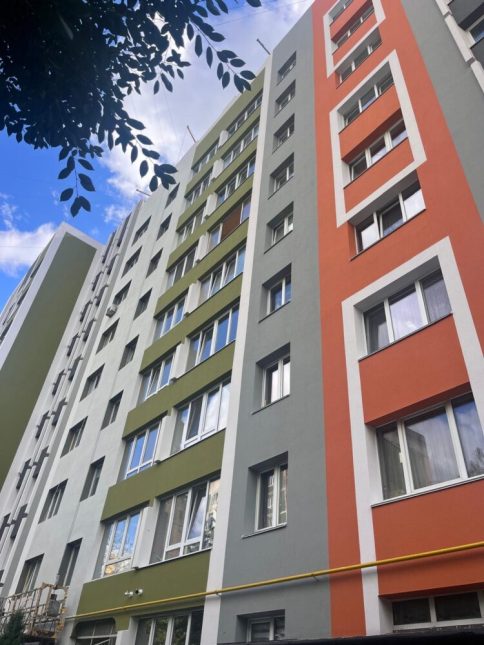
“This is our neighborhood of elite Sykhiv panel buildings,” says Tetiana Afanasieva, housing manager and project manager, with a note of pride. Indeed, right behind the Shuvar shopping center, streets of freshly painted, tidy high-rises begin, while shabby panel buildings, by contrast, stand out from the landscape. But for residents, renovation isn’t just about restored facades. That’s more of a bonus — the primary goal is to insulate buildings, eliminate heat loss, repair internal networks, and give everyone the ability to independently regulate the heat supply to their own apartment.
“Hnata Khotkevycha Street is one such example. I think that in a few years there won’t be a single unrenovated building left here,” says Tetiana Afanasieva. “I’ve personally been overseeing projects under the Energy Efficiency Fund’s programs since 2020. Together with the heads of homeowners’ associations, we’ve already completed 24 projects, and 39 more are currently underway. Of course, before the full-scale war it was simpler, although that was the beginning and it was harder to convince residents. Now, even the war doesn’t get in the way — residents come together and make decisions about modernization. Because it changes not just comfort, it changes quality of life, utility bills, it changes energy consumption. Accordingly, we’re gradually shifting people’s mindset and their attitude toward their own building, their own home — buildings into which they invest not just money, but their own effort and energy.”
Residents’ contribution is up to 30% of the project cost
Carrying out thermal modernization of a high-rise on their own is beyond the financial means of most residents. But thanks to the European Union, which supports the Energy Efficiency Fund, as well as the German government’s advisory project GIZ, residents’ contribution amounts to up to 30% of the project cost, or even less. And this isn’t an expense — it’s an investment that pays for itself quickly through a significant reduction in utility bills.
On behalf of the German government, GIZ, together with the Lviv city authorities, selected Sykhiv as a pilot district for implementing energy-efficiency measures.
“Our shared goal is to reduce the need for housing and utility subsidies and to improve comfort in homes. To this end, we analyzed the technical condition of buildings in Sykhiv, the number of subsidy recipients, and the level of energy consumption. At the next stage, together with residents, we identified a list of necessary energy-efficiency measures, such as facade insulation, modernization of ventilation systems, and the replacement or installation of heating devices that allow temperature regulation in apartments. Thermal modernization of residential buildings in Sykhiv will save resources, reduce energy consumption, and, in the future, cut greenhouse gas emissions. Energy-efficiency measures are being implemented under the Energy Efficiency Fund’s programs. We understand how important such projects are, and we support them. The experience gained will be useful for other districts and cities in Ukraine,” emphasised Eike Meyer, director of the GIZ project “Energy-Efficient District of the City of Lviv”.
“We support the Energy Efficiency Fund’s projects because we understand how important this is for Ukraine. Homeowners’ association associations can receive a grant covering up to 70% of the cost of thermal modernization projects, or 100% coverage of costs for restoring buildings destroyed as a result of hostilities. But here too, it’s not just about reconstruction — it’s also about implementing energy-efficiency measures. Since the project began, we’ve already been able to restore normal life for more than 130,000 families, for more than 1,500 buildings, and we currently have work underway to restore another 500,” added Eike Meyer.
The building achieved 70% savings on energy resources
“Right now, my heating bills in winter come to 800–1,000 hryvnias for my two-room apartment. Before, we used to pay 3,500 a month. There’s a thermostat on every radiator, and it’s very convenient that you control a comfortable temperature yourself, instead of freezing or opening windows and heating the street,” says Natalia Horbata, a resident of 40 Chervonoi Kalyny Ave. “On top of that, we had a lot of problems with the building itself. The roof was leaking, and it leaked all the way up to us on the 15th floor too. The networks were old and worn out, we were constantly fixing something.”
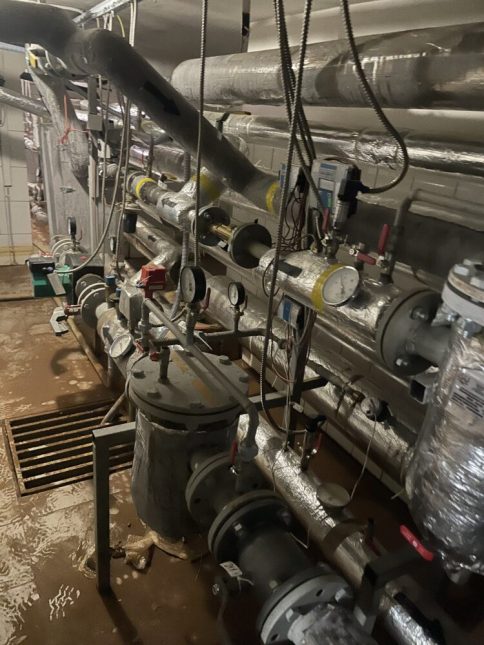
The homeowners’ association “Kalyna-40” is a participant in the state programs “Enerhodim” and “GreenDIM” of the Energy Efficiency Fund, which provides grants with EU support. Thanks to comprehensive energy-efficiency measures, the panel building achieved 70% savings on energy resources. The walls and roof were insulated, engineering networks were upgraded, a 30 kW inverter was installed, along with solar panels generating 32.76 kW of solar energy and batteries storing 41 kWh. As a result, in case of blackouts, the building has an uninterrupted power supply for elevators, water and heat supply pumps, as well as lighting in common areas. The total cost of the “Enerhodim” project was UAH 15,844,958; the “EnerhoDIM” project cost UAH 1,605,990.94.
“I can calculate, using my own two-room apartment as an example, how much the work cost us. First, we replaced the windows and balcony structure — that was about 30,000 hryvnias, while the full cost was almost 100,000. Our contribution to facade insulation was also about 30,000 hryvnias,” says Olha Tertychna, a resident of 40 Chervonoi Kalyny Ave. “We actually became the first building in Sykhiv where a comprehensive retrofit was carried out — it started with replacing windows and balcony structures. Then gradually we started doing other work: retrofitting radiators, installing thermostats, installing meters, and after that, insulating the building’s facade — and our building became a kind of beacon in Sykhiv. Others started following our example. People came to look, asked how we managed it, how long it took, how much it cost — the economic aspect was central here: savings, aesthetic appearance, comfort.”
“The strongest argument is savings”
Properly preparing documents and navigating all the nuances of energy-efficiency programs isn’t always easy for homeowners’ associations, especially when facing it for the first time. Halyna Kohut is an E-Team member, a Lviv-based energy-efficiency expert, and someone people can turn to for help. She also helps calculate costs for residents and convince them of the benefits of energy-efficiency measures.
“What are the strongest arguments to convince a building’s residents? In my opinion, the strongest argument is savings. That’s the utility bill. In other words, if a resident, say, paid 700 hryvnias in January for their apartment’s heating, while a resident of a neighboring, non-insulated building paid 2,200 or 2,500 — that’s the very first argument that helps people understand this isn’t just spending money, it’s an investment. The money invested pays for itself within 3–5 years after you start saving, after the projects are implemented. Another important argument is the rising value of the property, because an apartment in a modernized building costs 10–15%, or even 20% more than an apartment in a building where those measures haven’t been carried out.
Besides, here it’s clean, pleasant, everything is new — it’s practically a new building, made with quality materials,” says Halyna Kohut.
Author: Valeriia Sarancha
Source: Lviv Post