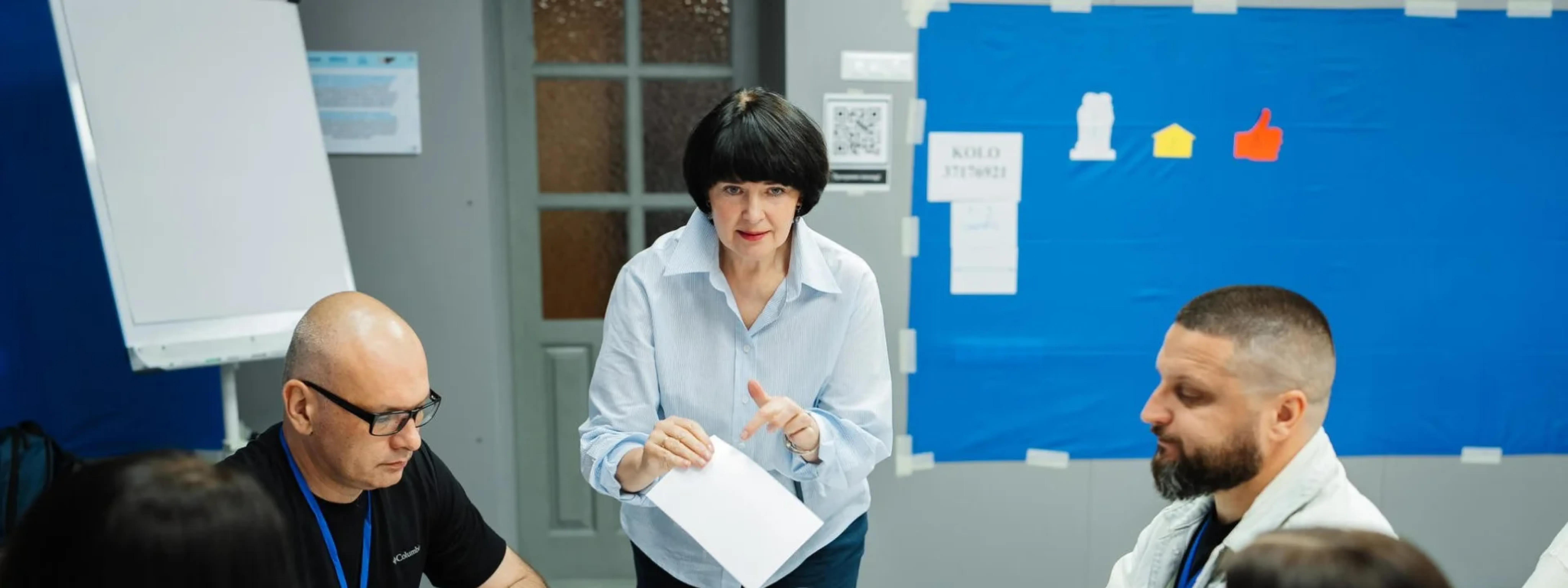
Communities across eight oblasts of Ukraine have completed a series of 24 strategic planning sessions to develop plans and recommendations for local programmes to reintegrate veterans.
The series of strategic sessions was organised as part of the flagship EU4Recovery partnership between the European Union and the United Nations Development Programme (UNDP), co-funded by the Government of Sweden, and with support from the Government of Denmark.
The sessions took place in the Sumy, Kharkiv, Chernihiv, Poltava, Dnipropetrovsk, Kherson, Zaporizhzhia and Mykolaiv oblasts as part of UNDP’s Area-Based Recovery approach. This helps communities design integrated solutions that combine stronger local service delivery, enhanced institutional capacity and comprehensive support for veterans.
The strategic planning process brought together representatives of local authorities and communities; veteran support specialists; veterans, families of those deceased, missing or held in captivity; representatives of veterans’ civil society organisations; and professionals from the social, health care, and legal sectors. In total, 675 participants took part in the sessions.
The primary objective was to develop plans and recommendations for local veterans’ reintegration programmes and strengthen coordination among all service providers, including local governments, Territorial Centres for Recruitment and Social Support, Administrative Service Centres (ASCs), health care institutions, employment services, social service providers and civil society organisations.
The resulting action plans will help communities move from fragmented assistance to comprehensive local reintegration systems, where institutions work in a coordinated manner and veterans and their families can access the support they need without unnecessary barriers. Based on the outcomes of the strategic sessions, communities identified several priority actions to implement by the end of 2028:
- Strengthen local governance of veterans’ policy by establishing advisory bodies, including veterans’ reintegration councils, reinforcing dedicated municipal units and building the capacity of local government staff.
- Introduce coordinated veterans’ support pathways from the first point of contact to the delivery of services, including a single entry point to coordinate assistance across all service providers.
- Expand the network of veterans’ centres as community hubs where veterans and their families can access services, receive advice, connect with specialists and participate in community life.
- Increase opportunities for economic reintegration through support for veteran entrepreneurship, vocational retraining, employment and business development.
- Make communities more accessible and barrier-free, including by engaging veterans in assessing the accessibility of public spaces and strengthening local accessibility policies.
- Enhance psychosocial support, expand peer-to-peer assistance, and implement public awareness campaigns that promote respect for veterans and their contribution to society.
“Their reintegration should be developed with veterans, not simply for them,” said Henrik Huitfeldt, Acting Head of Cooperation at the EU Delegation to Ukraine. “Through EU4Recovery and other programmes, the European Union supports local initiatives that help veterans return to civilian life, take part in community decision-making, start businesses, and find jobs.”
Find out more
News
-
EU supports development of training centres for the Armed Forces of Ukraine
-
The EU Ambassador to Ukraine, Katarina Maternová, discussed with teachers from Kyiv how to bring the EU closer to young people in Ukraine
-
Poltava Polytechnic has opened Building “F”, renovated with EU support: the renovation cost nearly €1.76 million
-
The EU and France have allocated €4.5 million for the reform of state asset management in Ukraine
-
With EU and Polish support: a modern Psychosocial Support Centre has opened in Bilhorod-Dnistrovskyi
-
A Centre to Assist War Victims Has Opened in Odesa with EU Support