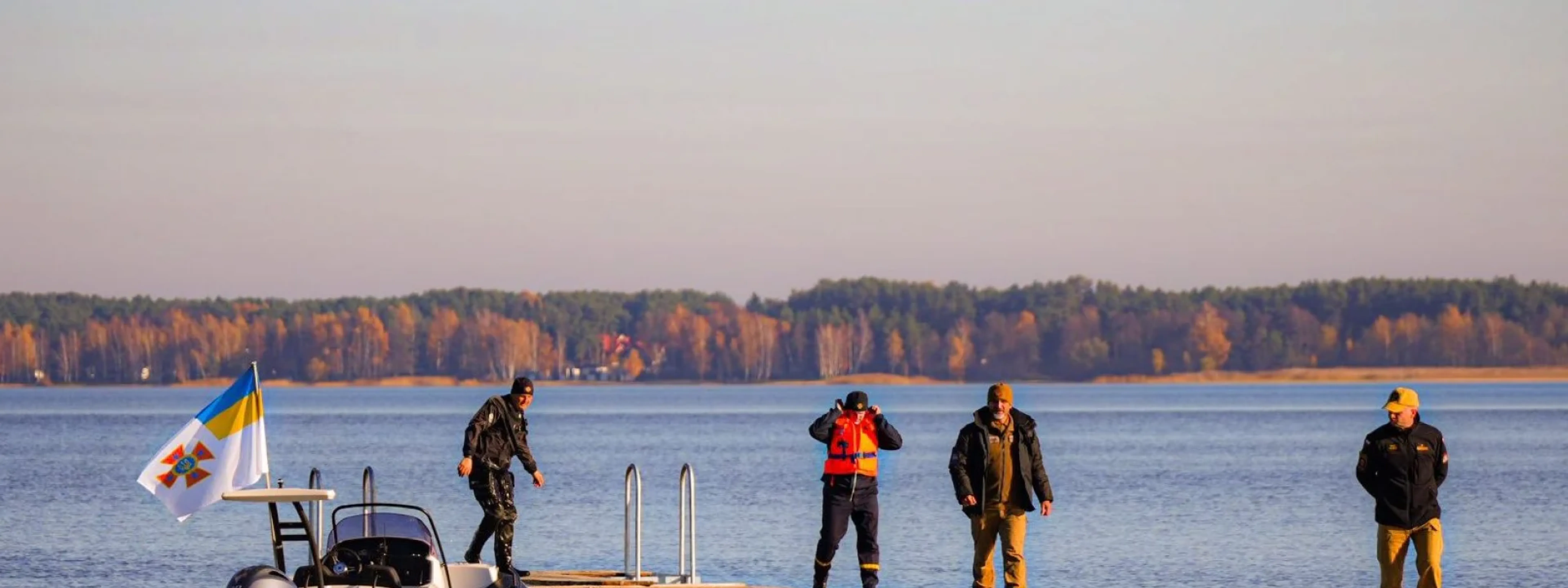
SVITYAZ LAKE (Ukraine) – As the lake breaks its boundaries, the alarm siren pierces the air. Within moments, a command van becomes the operational centre: its doors swing open, antennas rise, screens flicker on. A drone is launched to map the waters and identify rescue priorities. Swamp amphibious vehicles rush forward to evacuate people, rescue water scooters speed across the flooded terrain, and drinking-water tankers roll into position. Two mobile filtration units are activated to counter contaminated water, while evacuees receive health checks, dry clothes and warm drinks. It is only a drill, but the speed and tension feel very real…
A flooding-prone region
Today we are in Svityaz, home to the deepest lake in Ukraine and a popular summer tourist destination. Located in the north-west of the Volyn region, it borders Lublin Voivodship in Poland. This area is rich in lakes and rivers, as well as large forests. It is prone to floods and wildfires, and rising threats from climate change are making these natural disasters more frequent. Over the past few years, the Volyn region has experienced several acute spring flooding episodes: melting snow has caused rivers to swell, farmland to be inundated, roads and bridges to be damaged and rural communities to struggle with flooded households.
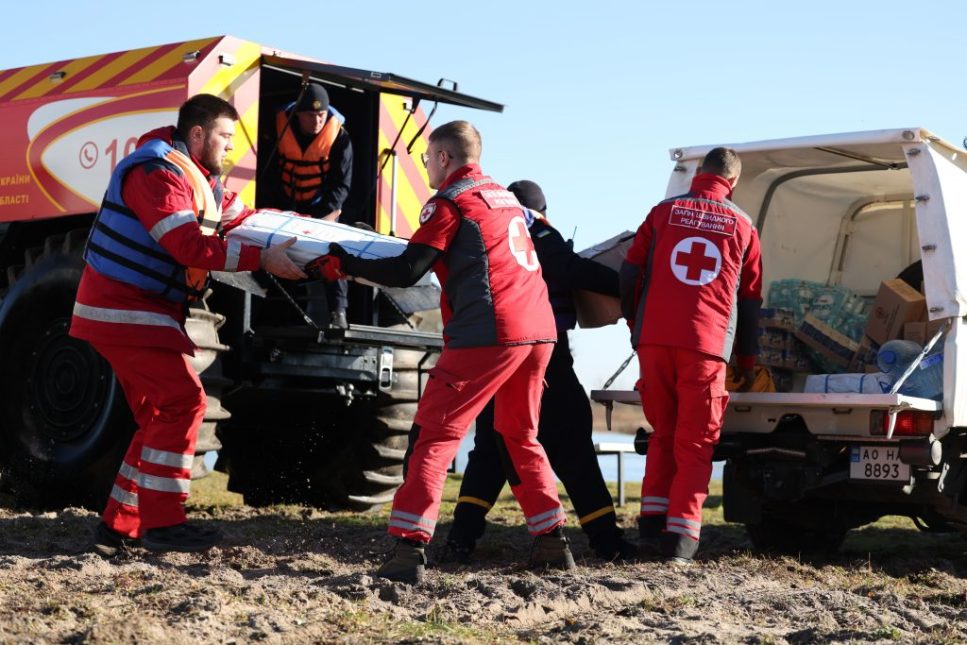
Today at Svityaz, the Ukrainian and Polish rescue services are holding a joint emergency drill to test their response capabilities and try out new equipment procured through two EU-funded Interreg NEXT projects: RESPONSE and HYDROGUARD. “Training to prepare for emergency situations has become essential,” says Yuri Bilaniuk, a Ukrainian rescuer working under the Main Department of the State Emergency Service of Ukraine in the Volyn region. “In 2025 alone we were involved 59 times in pumping water from homes and farmlands of people who needed help.”
A drill to test capacities
Strengthening rescue capacity begins with modernising equipment. Thanks to RESPONSE – implemented within the framework of the Interreg NEXT Poland-Ukraine Programme – the four partners implementing the project (three of them Polish) have acquired a wide range of tools. Particularly, Ukraine has received four specialised vehicles for transporting personnel and delivering drinking water, and a water tanker. “Our Main Directorate takes part in four Interreg NEXT projects,” comments Andrii Vovguk, deputy head of the State Emergency Ser ice of Ukraine. “This equipment is very modern and enables us to enhance our rescue capacity, and to react to different types of emergencies as fast and efficiently as possible.”
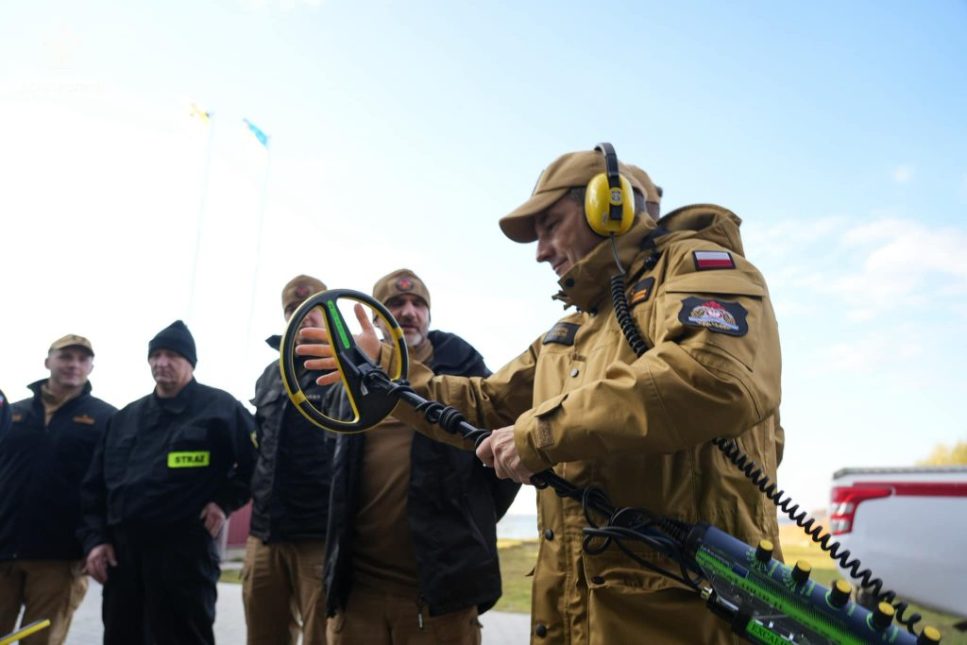
Acquiring new equipment is an essential step, but equally crucial — particularly in a cross-border context — is the exchange of experience and best practices between teams, along with the development of true operational interoperability. “Sharing knowledge and strategies help to build stronger, more coordinated teams,” continues Yuri Bilaniuk, “and today we are proud to be able to show to our Polish colleagues how to operate the new equipment”. The cross-border added value is confirmed by Michal Fijolek, a Polish rescuer: “We are learning a great deal from our Ukrainian partners, who have strong experience in using drones and amphibious vehicles in challenging terrain. We see the potential to apply similar solutions in Poland. This exchange is helping us to understand how and when to use this equipment in the best possible way.”
Underwater demining
And then there is the underwater part. The HYDROGUARD project focuses on rescue operations under water, particularly in demining, a capability of critical importance during a war, when rivers, lakes, ports or coastal areas often become strategic targets. Explosive devices can be placed on riverbeds, near bridges, dams, ferry crossings, aiming to disrupt transport, or to block supply routes. What is worse, unexploded ordnance can remain submerged long after fighting has stopped. And floods – particularly in regions already exposed to high water levels – could later uncover these devices, increasing the risks for fishermen, transport operators and local communities. That is why demining is essential. But water blocks normal radio signals, so without specialised equipment, divers would rely only on rope indications or limited hand gestures. Taras Pristup, a Ukrainian diver, is proud to highlight the advantages of the new communication station: like a “voice-bridge” between underwater and land. “This station includes a headset and microphone in the diver’s helmet,” he says, “and a monitoring and recording equipment operated by the supervisor, on the surface: divers can report problems in real time and receive immediate instructions”.
Clearing underwater ordnance serves multiple purposes: it protects civilians, it ensures safe navigation, it safeguards infrastructure. In a cross-border context, it also reduces environmental and security risks along common rivers or other waterways. “We have received advanced diving station systems, hydroacoustic communication sets, metal detectors and oxygen-testing equipment,” continues Yuri Bilaniuk. “These tools enable our divers to find and remove mines and shells.” Specialised drones can also be deployed in these demining operations. “Thanks to the project,” he concludes, “we have what is currently the only testing stand for equipment used by underwater rescuers in Ukraine”.
Real, operational capacity to protect populations
Ultimately, projects like RESPONSE and HYDROGUARD demonstrate the tangible value of cross-border cooperation for regional communities. By combining modern equipment with joint training, shared standards and coordinated response mechanisms, they transform preparedness into real, operational capacity. The result is not only stronger institutions, but safer citizens. Overall, through the acquisition of new technologies and the concrete implementation of these initiatives, the level of protection has been significantly reinforced for a population of approximately five million people living along the border.
Author: Daniela Cavini