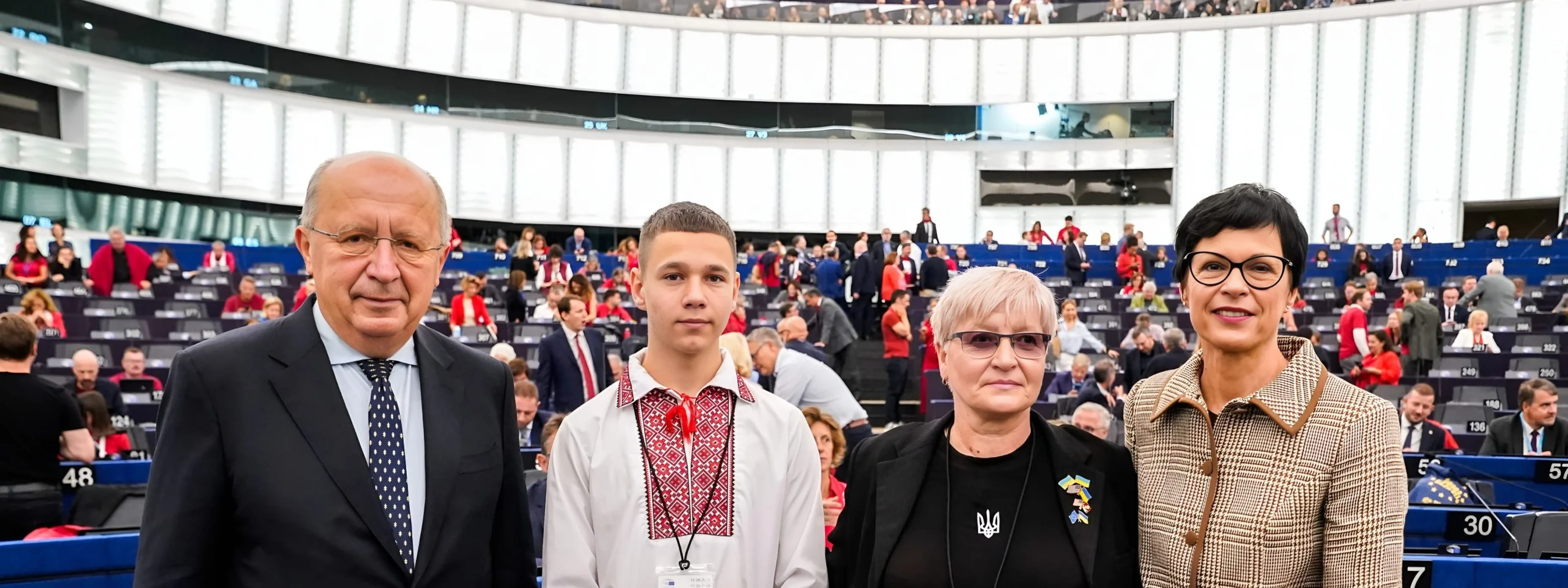
In 2022, 11-year-old Sasha Radchuk was living with his mother Snizhana in Mariupol. When Russian forces occupied the city, they separated Sasha from his mother, put him through a so-called filtration camp, and took him to occupied Donetsk. From there, the plan was to give him up for adoption to a Russian family.
In this story, we examine the testimonies of Ukrainian children like Sasha, and present evidence from human rights defenders and activists confirming that Russia’s actions against civilians are clearly planned, and that the large-scale effort to return and rescue children is not over.
“The Russians told me that my mum didn’t need me, that I would be given to a foster family in Russia. Imagine – they didn’t even let me say goodbye,” Sasha recalls in his testimony about the events in the filtration camp.
The removal of children during the filtration process is one of Russia’s schemes. This is confirmed by the testimonies of Sasha and other children, whose statements have been collected by the Ukrainian humanitarian programme Bring Kids Back UA.
Sasha survived a severe shrapnel injury during the battle for Mariupol, captivity by Russian forces, and thanks to his courage and resourcefulness, he managed to escape.
“I begged a guy for a phone and quickly, in the toilet, called my grandmother – literally for one minute – and told her where I was,” he said.
Incredibly, his grandmother Liudmyla travelled thousands of kilometres through Ukraine, Poland, Belarus and then Russia to find him in Donetsk and get him back.
Last year, Sasha attended a session of the European Parliament. His grandmother sat beside him. He personally, his family, and the struggle of all Ukrainians for freedom were recognised by President of the European Commission Ursula von der Leyen in her annual address to Parliament.
Sasha is now 15 years old, and lives safely with his grandmother Liudmyla. To this day, however, Sasha doesn’t know what has happened to his mother Snizhana.

The abduction of civilians was clearly planned
Yevhen Zakharov, Director of the Kharkiv Human Rights Protection Group, who is also Chair of the Board of the Ukrainian Helsinki Human Rights Union, said situations such as the disappearance of Sasha’s mother Snizhana are of particular concern.
“For three years, the Russian authorities have provided no official confirmation of her detention in any status, despite numerous testimonies suggesting the possible involvement of state representatives. Also, none of the prisoners who have already been exchanged has, unfortunately, seen Snizhana in places of detention. In such circumstances, the risks to the life and health of detainees increase significantly,” says Yevhen Zakharov.
Abductions and enforced disappearances of Ukrainian civilians have become widespread.
“Most often, people are detained at filtration points or seized in occupied territories on suspicion of disloyalty to the occupation authorities. Sometimes people are captured following denunciations or reports from local residents. Then the fate of the abducted person may unfold in different ways. He or she may be officially detained with charges brought against them or held unofficially without contact with the outside world,” the Director of the Kharkiv Human Rights Protection Group explained.

To draw attention to the problem, human rights defenders working with other partners have created the Tribunal for Putin (T4P) initiative, as well as the APUS project.
“The resource is run by the Kharkiv Human Rights Protection Group. The website has seven language versions – Ukrainian, English, French, German, Italian, Spanish, and Russian. The initiative was founded on 24 March 2022. The project – now into its second phase – is funded by the European Commission, and implemented by the Kharkiv Human Rights Protection Group” Yevhen Zakharov added, referring to the ‘T4P’ project.
Research and documentation of war crimes are the areas in which the organisation receives the most support, from the EU and separately Sweden, the Netherlands, and Denmark. “And during the recent shelling, when there was no electricity and no possibility to work properly, we turned to our partners, and our colleagues received charging stations,” one of the journalists of the human rights organisation, Iryna Skachko, confirmed.
She explained that journalists also actively covered the work of lawyers who submit materials to the International Criminal Court and support the documentation process.
“And one of these submissions was specifically devoted to the forcible transfer of children from Ukraine to Russia, and the lawyers substantiated that such actions correspond to the elements of genocide,” Iryna said.
Taught to write in Russian
Across all of Russia’s actions against Ukrainian children, a deliberate policy can clearly be observed. A telling example is the story of nine-year-old Illia from Mariupol, who not only endured ‘re-education’, but also lost his mother. At the height of the Russian assault, when the city became completely unsafe and food was scarce, he and his mother decided to go to their neighbours’ house. At that moment, shelling began. Illia’s leg was shattered. His mother sustained what would turn out to be a fatal head injury. But she gathered her last strength and carried the boy to their apartment. They lay down on the couch, and his mother died in her son’s arms.
“The neighbour buried my mum in our own yard, near our house. They didn’t just kill my mum – they literally gave neither her nor anyone in Mariupol a chance to survive. They treat civilians as some kind of main enemy of peace,” Illia says.
Family acquaintances took Illia in, but when they attempted to leave for Ukrainian-controlled territory, the boy was taken away. Illia was transported to the occupied city of Novoazovsk, and from there to Donetsk. There, in a hospital, they tried to turn him into a propaganda tool.
“They taught us to write in Russian. And once my doctor came up to me and said that from now on I would say not ‘Glory to Ukraine,’ but ‘Glory to Ukraine as part of Russia’,” he recalled.
Like Sasha, Illia was rescued by his grandmother, after a distant relative saw him on Russian television and recognised his face.
Various organisations are helping to collect testimonies, including the coalition of human rights organisations Ukraine 5 AM Coalition, which also includes the Human Rights Centre ZMINA.
Onysiia Syniuk, Head of the Analytical Department at ZMINA, explained that although in Russia’s actions against the Ukrainian people, genocidal intent can be observed, and these actions bear the characteristics of the crime of genocide, the legal confirmation of this fact requires time and active efforts from both the Ukrainian justice system and the international community.
“Here, it is indeed possible more to clearly trace the system that the Russian Federation is building against children, with the intent to destroy them as part of the group,” Onysiia Syniuk said.
She explained that although the word “destroy” is associated with killings, there is a whole range of actions that can fall under this definition. In particular, with regard to children, there is a specific provision – the transfer from one national group to another.
“Everything that the Russian Federation is doing in its entirety – not only deportation, but all measures – from changing school curricula to fully Russian ones in the occupied territories, introducing narratives justifying Russian aggression, physical actions aimed at changing the national identity of these children – imposing Russian passports on them and even transferring them to Russian families – this is an absolutely direct transfer of these children from one national group to another,” Onysiia Syniuk added.
In 2024, the Parliamentary Assembly of the Council of Europe adopted a resolution on the situation of children in Ukraine, which included a call on member states of the Council of Europe to recognise the deportation of Ukrainian children as genocide.

But these are, of course, political statements, and not yet a legal decision,” Onysia Syniuk concluded.
Leaving is possible
We spoke with Darya Kasyanova, Chair of the Board of the Ukrainian Child Rights Network, about how the process of returning and reintegrating children takes place.
Due to the complex system of multiple relocations, changes of documents, and the dangerous situation along the front line, the process of returning children is indeed difficult.
Organisations involved in returning children often deal with the most complicated cases: children who have lost their parents, were separated from them, or have parents serving in the Ukrainian military. Such circumstances automatically create additional risks.
“And we have cases where we work on a single child’s return for up to nine months. The most recent such complex case involved a boy who had to be evacuated from temporarily occupied territory. He was in a shelter and under total control. The return was preceded by a long period of preparation,” Darya Kasyanova said.
If in 2022-2023, when possible, relatives travelled to retrieve children in person, as in the case of Sasha and Illia, this is no longer an option. “The FSB checks and conducts interrogations – this can last eight hours or more. Mothers and grandmothers do not agree to this, and fathers who are serving in the military cannot do it physically because it is life-threatening. So we are looking for other options,” she explained.
Usually, parents – legal guardians – contact the organisation, and as a rule they know where the child is, but there are also cases where a real investigation must be conducted.
Given the regime of secret adoption in Russia, obtaining access to information about such a child is practically impossible. At the same time, most organisations focus on cases where children’s data have not been changed, although even there serious difficulties arise.
“We are also contacted by the children themselves – teenagers, young people. These are usually friends of the children we have evacuated and whom we support after their return. And they say: ‘You helped my friend, my brother, my sister – and I also want to leave.’ Or they say: ‘I am here with my mum, and she is very afraid. Can you somehow speak with her, explain?’” Daria Kasianova explained.

She says there is a kind of information vacuum, and that people often do not know that it is possible to retrieve children.
“On the contrary, Russia spreads information that it is very dangerous, that Ukraine arrests people, that children will be sent to orphanages, and so on,” she added.
At the Ukrainian Child Rights Network, they try to inform people and provide examples of where to seek help.
Returning home is only the beginning of the journey
Ukraine is currently building a system for the return, reintegration, and protection of affected children. In May 2024, the Government adopted Resolution No. 551.
“We were also involved as a civil society organisation. It outlines the entire algorithm for reintegration and social support for families with children and young people up to 23 years old. The Resolution is funded by international partners through UNICEF, and we are the implementing partner of the state,” said Darya Kasyanova.
The assistance consists of three packages. The first is short-term, up to three months: after crossing the border, a needs assessment is conducted, and depending on the results, humanitarian, financial, and hygiene assistance is provided, as well as support with housing rent, document restoration, and psychosocial support. The second package (3-6 months) covers rehabilitation, possible medical treatment, continued housing support, and educational services, while the third – long-term (up to 18 months) – includes full support with a case manager and a social worker in accordance with an individual plan.
“In fact, everything depends on what the child or family has gone through. Often, children go for rehabilitation together with their parents. In some cases, there is a need to involve a psychiatrist, and there are also situations where the child adapts better while the parents cannot cope,” said Darya Kasyanova.
According to data released by President Volodymyr Zelenskyy, since the beginning of the full-scale invasion, Ukraine has managed to bring home 2,000 Ukrainian children who had ended up in temporarily occupied territories or in Russia. However, thousands of Ukrainian children remain hostages of Russia and continue to fall victim to its crimes every day.
“Russia is obstructing the return by all possible means. It does not provide information about those it deported, although there are direct demands from both Ukraine and international partners – for example, the UN General Assembly resolution on the return of Ukrainian children requires this. And this also indicates that it is a deliberate policy – not to return the children, to keep them within this sphere of influence, and to make them Russian, both by passport and by maximally influencing them mentally,” said Onysiia Syniuk, Head of the Analytical Department at ZMINA.
Author: Olga Konsevych
Article published in Ukrainian by TSN.ua