
What will your municipality be like in 2034? This is the question that we’d like to start with as we tell you about New Horizons, a U-LEAD project to help 64 municipalities work on new development strategies, analyse data, set priorities and find solutions that turn strategic goals into concrete projects and changes for residents.
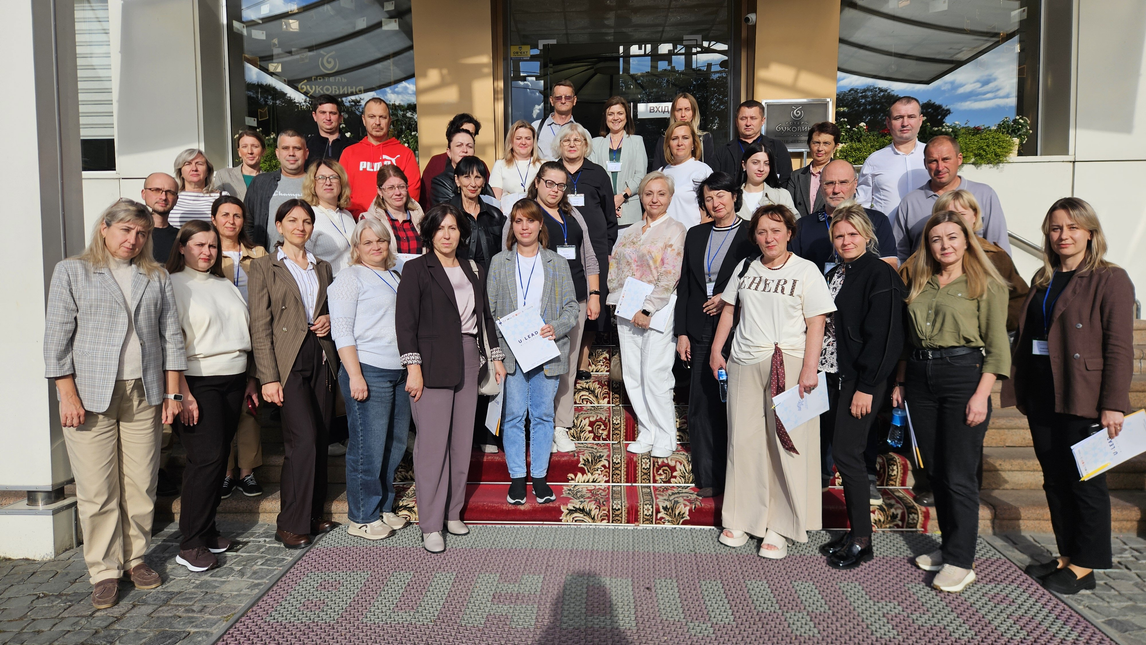
The initiative’s first event has already taken place in Chernivtsi. Participants were introduced to its scope, the main stages of the work and the tools they will be using throughout the year. There was a separate discussion on the key strategy-setting actors and the distribution of roles amongst them, as this important and extensive work will require synergy.
More than just a strategy on paper: a logical system for managing development
The new planning period will cover the years 2028–2034 and will be synchronised with the European Union’s planning cycle. For Ukrainian municipalities, this will involve preparations taking place amidst ongoing war, demographic changes, the need for reconstruction, and the simultaneous alignment with European planning approaches.
New Horizons is not just about drafting a new strategic document. The initiative aims to establish a comprehensive development management system within municipalities, from monitoring, data analysis, and the identification of needs and priorities to spatial, investment and project-related decisions.
The training will be combined with one-on-one expert support, hands-on work, networking and the exchange of experiences between municipalities. This approach is meant to ensure that, once the initiative is complete, the municipality is equipped not just with a document, but with a team capable of using it and implementing the planned changes.
That said, U-LEAD experts will not be drawing up “turnkey” strategies for the municipalities. The municipalities themselves will work on the documents, receiving the necessary expert support — so that they, and they alone, are the architects of their own future.
Change for the people
A development strategy should not begin with a list of projects the municipality wishes to implement; rather, it should start with an understanding of who these projects are for and what changes they are intended to bring about.
This perspective helps us see beyond the figures and buildings to the real needs of people, and makes decisions fairer and more informed.
Ultimately, a strategy is not a plan for the development of a territory for the territory’s sake. It is a tool designed to improve people’s lives: to provide opportunities for work, self-fulfilment and well-being.
At the launch of New Horizons, we asked the initiative’s participants themselves — who also live and work in their municipalities — how they envisage their municipalities in the future and what changes they consider key.
Serhii Iskra, the Deputy Head of Turbiv Settlement Council for the Operations of the Executive Bodies of Vinnytsia Oblast Council, expects that the new strategy will help the municipality move from recovery to sustainable economic and social development:
“In 10 years’ time, following the design and implementation of a development strategy with the support of U-LEAD with Europe, we are confident that Turbiv municipality will be able to transition from basic recovery to sustainable economic and social growth.
We firmly believe that the methodology already presented during the first module — involving an analysis of resource potential, engagement with the business sector and the public, and a focus on European approaches and standards — will enable the municipality to thrive.”
He identifies the development of agricultural processing as one of the most promising areas for Turbiv municipality.
“Much of our municipality’s land is agricultural, and agricultural producers are among the main economic actors. We expect that, over time, they will be able to form a cluster focused not only on the production of raw materials but also on their processing.
There are already farmers and entrepreneurs in the municipality who have taken steps in this direction. There should be more businesses like this. This will enable us to create added value directly within the municipality, generate new jobs and increase revenue for the local budget.”
Another area of focus is energy independence, green energy and support for local businesses. The municipality is also considering the possibility of setting up a business incubator-type entity that could advise entrepreneurs and help them make use of available grant opportunities.
“If we create favourable conditions and help our entrepreneurs secure grant funding to develop their businesses, this will ultimately have a positive impact on the development of the municipality as a whole.
The municipality exists for the people, and we must consult with local residents, utilise various forms of participation, and gather a range of ideas.”
For Olena Chumachenko, the First Deputy Mayor of Pereshchepyne in Dnipropetrovsk Oblast, the future of the municipality is linked, above all, to peace, economic prosperity and support for veterans.
“A strategy is, after all, the roadmap for our lives. The main thing is to see our municipality as peaceful and successful, both economically and socially. We want it to be prosperous, and we want the veterans who return to be protected here. We are currently planning to build a rehabilitation centre here, within our outpatient clinic.
We don’t have our own healthcare facilities, so we co-fund the provision of medical services in neighbouring municipalities. That is why we’re moving more in this humanitarian direction.”
Valentyna Dalibozhak, the Deputy Head of the Economic Development Department of Smila municipality in Cherkasy Oblast, cites the opportunity to combine various municipal development processes and foster genuine engagement from the public and the business sector as one of her expectations from the initiative:
“For us, participating in the initiative is an opportunity to put into practice the reform of public investment, municipal powers and strategy.
We would like to understand how best to involve the public and the private sector in this process — not just as a formality, but in a meaningful way. It’s good that we can discuss this with colleagues: how these processes are organised elsewhere, what the advantages and disadvantages are. Sharing experiences is also a great benefit.”
The issue of public engagement in strategy development will be a cross-cutting theme within the initiative. Participants will focus on identifying stakeholders, mechanisms for public participation, and organising discussions on draft strategic documents.
For Alla Stetsiuk, the Head of the Department of Economic Development, Investment and Project Management at Kremenets municipality in Ternopil Oblast, peace remains the fundamental prerequisite for any long-term planning:
“I see our municipality as thriving, prosperous and peaceful. Above all, we need peace; only then can we plan properly. In today’s context, this is very difficult.
We were motivated to join because we were already updating our existing strategy. We were impressed by both the U-LEAD experts and the support team. We want to continue with this as we realise that our own knowledge is not enough; we need help.”
The first practical phase has already begun
Following the kick-off event, participants moved on to the first training module, which focused on monitoring and evaluating existing municipal development strategies.
It is essential to understand that a municipal development strategy does not start from scratch. The first step is an honest and thorough assessment of how the municipality has implemented the current strategy: what has been successful, what has not worked, which decisions have delivered results, and which have remained in the planning stage. This analysis will help municipalities build on valuable lessons learnt, move away from ineffective approaches and put together a new strategy based on real-world experience. Therefore, monitoring the current strategy is not a mere formality, but the starting point for a new planning cycle.
This was the starting point. Following the in-person session, the activities will continue as individual and group consultations throughout September and October.
At the same time, municipality leaders took part in study visits to the municipalities of Khotyn, Sucheveny and Rukhshyn in Chernivtsi Oblast. This offered an opportunity to witness their peers’ experiences first-hand, discuss management decisions and compare approaches to territorial development.
Not just a document, but the ability to implement it
The initiative is expected to result in 64 municipalities having developed development strategies, whilst over 250 officials from local council executive bodies will expand their expertise and develop practical skills in strategic planning.
However, the New Horizons initiative is about more than just prepared documents or even trained teams. It is vital that the municipalities see the positive changes their residents need and dream of. And that is exactly what we aim to work towards.
Author: Maryna Havrylenkova
Source: U-LEAD with Europe
Background information
U-LEAD with Europe programme is a partnership of the Ukrainian government and the European Union and its member states Germany, Denmark, France, Austria, Poland and Slovenia to support the establishment of a multi-level governance that is transparent, accountable and responsive to the needs of the population of Ukraine.
The programme’s purpose is to strengthen the capacities of key actors and stakeholders at national, regional and local levels in order to enhance local self-government in municipalities, also during the times of war and recovery.