
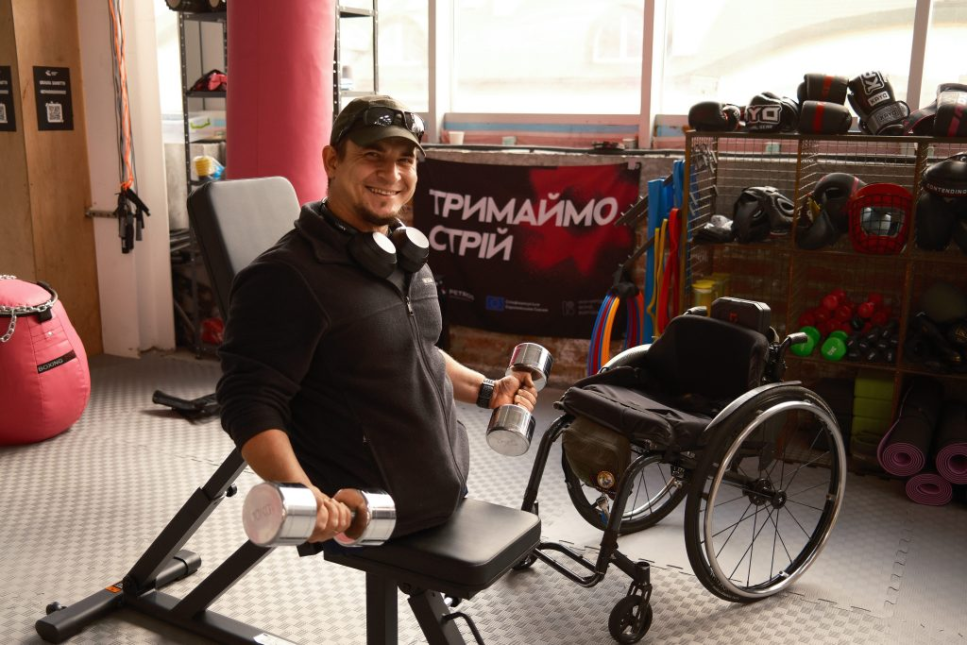
When Artem Peredereiev, 36, woke up after the amputation of both his legs, he could not imagine a future outside the hospital walls. A volunteer who joined the army in 2024, from a small settlement near Pokrovsk in Ukraine’s Donetsk region, he was severely wounded on the battlefield and brought to Ivano-Frankivsk for rehabilitation. His physical condition was poor, and emotionally he was depressed. “Everything was new and different. I had no place to return to because my hometown was occupied. I did not understand how to live further,” he recalls.
Every year, hundreds of wounded servicemen and women pass through the Centre for Physical and Rehabilitation Medicine at the Ivano-Frankivsk Regional Clinical Hospital. While healing the body, doctors know that this is only part of the recovery. “In Ukraine, patients are still often viewed mainly through a medical lens: what injuries they have and what treatment they need,” says Kateryna Zahorodnia, Head of the Centre. “But far less attention is paid to what happens next − how they will return to everyday life, find purpose and restore their peace of mind.”
It was in these hospital corridors that the local NGO ‘Re:TextileGroup’ found a new mission. When Russia started its full-scale invasion in 2022, the organisation began sewing sleeping bags, fire-resistant suits and adaptive clothing for wounded servicemen whose uniforms had been cut away during emergency treatment. Delivering these items to the hospital, the NGO’s team spent time talking to patients and medical staff. They soon realised that many veterans were struggling with loneliness, uncertainty and depression. “When we visited hospitals, we saw how painful recovery could be, sometimes lasting more than a year,” says Nataliia Naida, the head of Re:TextileGroup. “People may feel that nobody cares about them. They may simply give up, start drinking or taking drugs.”
Those encounters transformed the NGO’s work. What began as humanitarian assistance evolved into long-term social rehabilitation, helping veterans to rebuild their lives after leaving hospital. Through adaptive sports and peer support, the NGO’s team has been encouraging veterans to reconnect with others and begin looking beyond their injuries. “Why sport? Because it’s the cheapest and simplest thing that stimulates you to recover,” says Nataliia.
At first, Artem Peredereiev was simply invited to join an archery session in the hospital’s inner courtyard. But soon these sessions, run every week, outgrew the rehabilitation centre. Many veterans like Artem wanted to continue training after leaving hospital, prompting the NGO to create a permanent, accessible space where recovery could continue after medical treatment.
In 2024, the NGO established ‘Petros’, a permanent space for its activities. A year later, EU support through the International Renaissance Foundation helped the NGO to expand it into an inclusive sports club where veterans, their families and civilians could train side by side. Today, Petros offers adaptive archery, boxing, jiu-jitsu and other activities. More importantly, it has become a community where veterans regain confidence, build friendships and even discover a new profession.
For Artem, Petros became the beginning of a new chapter. He continued training at the hub, gradually mastering adaptive archery. After completing the School of Instructors, organised by the NGO, he was invited to join their team. Today, Artem coaches veterans in Olympic archery, helps run the inclusive combat sports club and regularly returns to rehabilitation wards to introduce newly wounded servicemen to adaptive sports. For many of them, meeting someone who has overcome similar challenges is the strongest motivation to take that first step. “Archery is one of the most adaptable sports,” explains Artem. “If someone can’t stand, they can shoot from a chair. Even a person without an arm can learn to draw the bowstring with the teeth.”
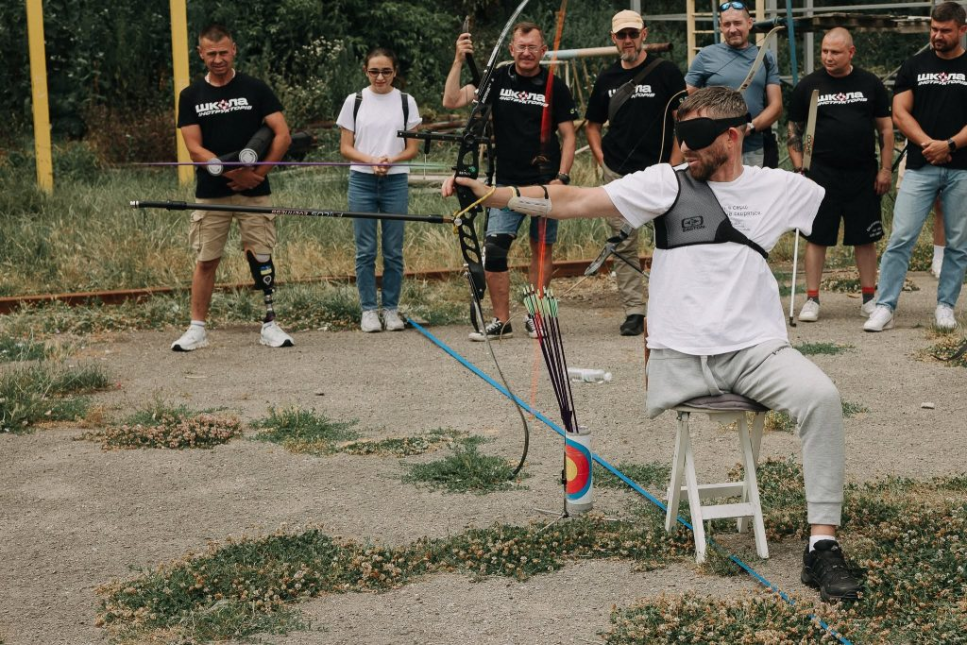
For some veterans, those first arrows mark the beginning of an entirely new life. After a severe injury and losing a leg in the war, 51-year-old Olexander Zirka joined Petros while undergoing rehabilitation, and discovered adaptive archery. The sport helped him to pursue new goals. In 2025, he became Ukrainian champion in Olympic archery for athletes with musculoskeletal impairments. This year, he represented Ukraine at the Marine Corps and Air Force Trials in the United States (an international adaptive sports competition for wounded servicemembers and veterans), returning home with four medals. Inspired by his own journey, he is now studying at a physical education college to become a professional coach.
Yet, the true success of Petros is measured not in medals, but in the confidence it restores and the possibilities it opens to continue life beyond injury. “When wounded guys look at me, they complain less,” says Artem Peredereiev. “If I can do it, they know they can do it too.” Out of 24 participants of the first School of Instructors, nine established local hubs or found employment in communities across the region.
But Petros is much more than physical activity. The space has grown into a community where veterans and their families rebuild everyday life together. Alongside adaptive sports, it offers leathercraft and woodworking workshops, trainings with rehabilitation specialists, psychological support, competitions and open events, and simply a place where people with similar experiences can spend time together. “We believe in healing through human connections. Sport and crafts simply create the space for those connections to happen,” says Nataliia Naida. “Petros is one big family. Here everyone encourages one another, and that’s what helps people move forward.”
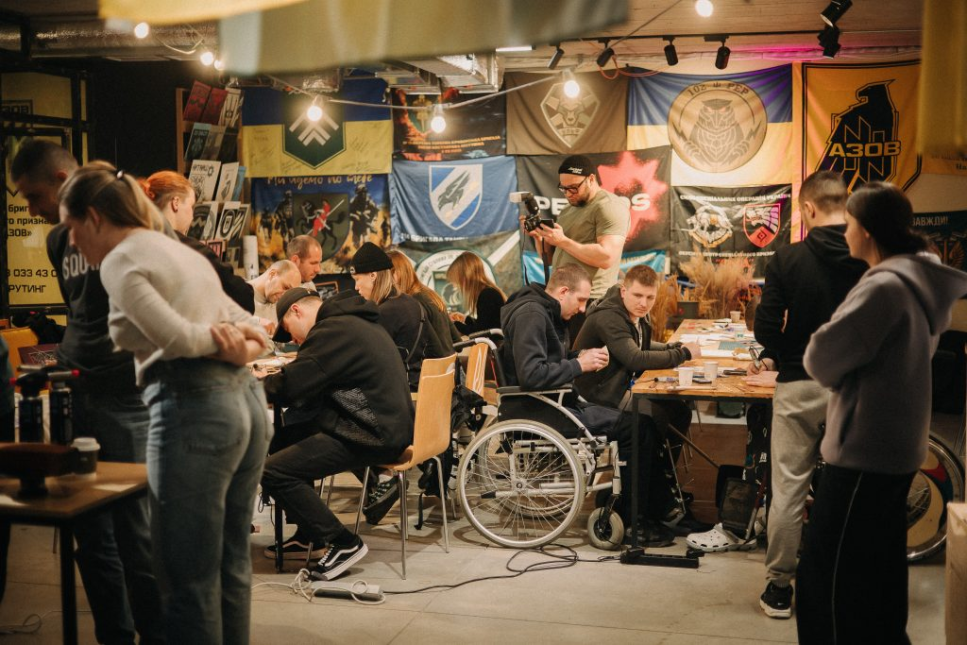
The idea soon spread beyond Ivano-Frankivsk. The NGO continued visiting rehabilitation hospitals while training veteran instructors to establish similar initiatives in other regions. Inspired by the Petros model, hubs have been launched in 16 locations across five Ukrainian regions: Mykolaiv, Kherson, Dnipropetrovsk, Kirovohrad and Chernihiv. “We believe that veterans can be drivers of change in their communities,” says the NGO’s head. “They want to make a difference, and our role is to provide the support they need.”
Today, more than 1.000 veterans and their family members have found a community through Petros. Yet its greatest success is seen when those who once arrived seeking support become the ones offering it. For Artem Peredereiev, this journey has come full circle: “At one time, Petros helped me. Now I help others.“
Authors: Volha Prokharava, Oksana Fedorovych