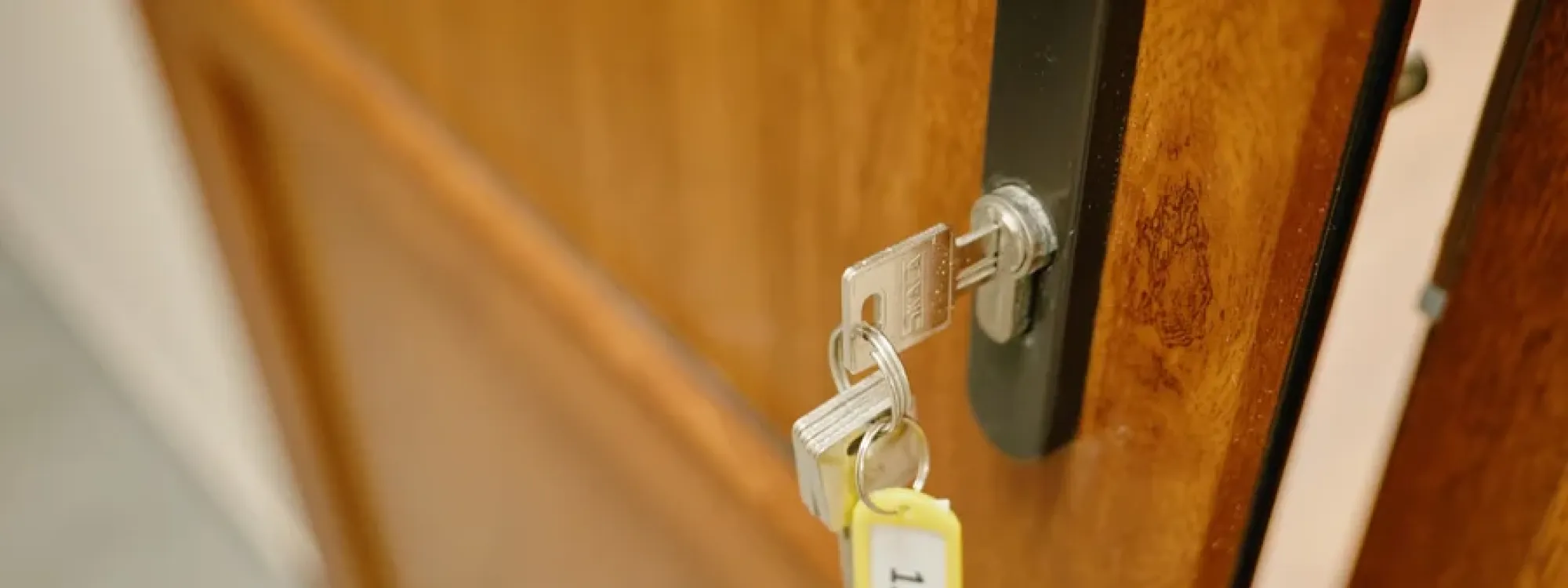
The full-scale war forced hundreds of thousands of Ukrainians to leave their homes, and communities to search rapidly for solutions. Thanks to support from the European Investment Bank (EIB) — the bank of the European Union (EU) — modern social housing has appeared in Cherkasy, where internally displaced persons can begin to settle into life in a new place in comfortable conditions.
Larysa Kosovska and her husband Valerii have been living in new social housing in Cherkasy since spring 2026. The home has become a second home for them, says Larysa.
In February 2024, the couple left Selydove in Donetsk Oblast. They did not want to leave their home until the very last moment, but staying was becoming increasingly dangerous: the front line was advancing. Living conditions were deteriorating: Russian shelling had left the city without water, heat, or gas.

“All educational institutions and hospitals in the city had already been destroyed, people were dying. My husband suddenly lost his sight due to stress. He began having panic attacks. We urgently needed to see specialists. So we left, taking our documents and a few personal belongings: my husband couldn’t see, and I had to lead him by the hand,” Larysa recalls.
The couple decided to go to Cherkasy because they had acquaintances there. Larysa shares that they thought they were leaving for a few months — they even left a second set of keys to their flat with the neighbours. Since October 2024 the city has been occupied by Russians, and they do not know what has become of their home.
“Leaving was hard — emotionally, materially, and physically. I reassured my husband that we were going on holiday — to get to know Cherkasy Oblast. And now two years and four months have passed,” Larysa recalls.
In Cherkasy, the family received the help they needed, but life was difficult: renting accommodation, paying utility bills, and buying medicine at the pharmacy were all expensive. Due to his loss of sight, Valerii was granted second-group disability status.
The family was offered a place in the new social housing created with EU support. It is one of two restored buildings converted into safe and functional residential accommodation.

The project was implemented with support from the EIB — the EU’s bank — under the Emergency Credit Programme for Ukraine’s Recovery — one of three joint EU and EIB initiatives with a total budget of €740 million, supporting communities in rebuilding social infrastructure. The programme is being implemented jointly with the Ministry of Restoration, Infrastructure and Transport, the Ministry of Finance of Ukraine, and local authorities, with technical support from the United Nations Development Programme (UNDP).
“We entered a cosy, tidy courtyard and saw two beautiful buildings. The ‘Shelter’ signs immediately caught our eye. It felt so reassuring that someone had taken care of us. We are protected, we are needed. When we lived in a flat, we didn’t know where to go during an air raid alert and just stayed at home,” Larysa admits.

The social housing can accommodate around 130 people in 47 rooms, not all of which are currently occupied. Larysa explains that each family has a separate room, furnished and equipped with everything necessary, while the kitchen, laundry, toilets, and showers are shared.
“The people here are lovely. You walk into the kitchen and someone is already cooking something. Whether you like it or not, you end up lifting each other’s spirits. We chat, say hello, have a conversation,” Larysa smiles. “Now my morning coffee tastes better and I feel calmer.”

The building is equipped with all amenities meeting barrier-free requirements: there is a lift, a platform lift, and bathrooms fitted out for people with reduced mobility. Another advantage is the convenient location: shops, pharmacies, and public transport stops are all nearby. But the most important thing, Larysa noted, is the friends they have made here.
“As soon as the heat eases, I dream of resuming Nordic walking with the friends I exercise with. These people were given to me by fate,” Larysa shares.
The social housing provides accommodation for IDPs, including older people and people with disabilities. In the building where Larysa and her husband live, almost everyone is of a similar age to them.
“We all have shared interests here. Each of us has been through so much that it is easier together. Everyone has their own story, but we try not to talk about it too much,” Larysa notes.
Selydove is now more than 30 km behind enemy lines. But Larysa believes in a peaceful future for Ukraine.
“There is nowhere for us to return to yet. The whole city is destroyed. And most likely everything there has been looted and smashed. But the war will end — we will wait for victory. This is our home now, even if only a temporary one,” Larysa adds.
At present, a total of 15 projects have been completed or are under way in Cherkasy Oblast under the EIB recovery programmes. Overall, the programmes cover more than 500 social infrastructure facilities — schools and kindergartens, hospitals, rehabilitation centres, water supply and sewerage systems, centralised heating, and social housing — in more than 300 communities across Ukraine.
This article was produced with the financial support of the European Union. Its contents are the sole responsibility of the Ukraine Recovery Programme and do not necessarily reflect the position of the European Union.
Source: NV